Professor Dean Brinson Died in a Hospital Wheelchair—And Met His Teacher on the Other Side
A vegetarian professor's argument with his wife ended in clinical death and a journey through multiple dimensions of reality
Professor Dean Brinson stopped talking mid-sentence. His wife kept speaking, wheeling him through the hospital corridor, not yet noticing that her husband had gone silent. She was still upset about their argument over money and the colonoscopy appointment he hadn't wanted. When she finally looked down and realized he wasn't breathing, she started screaming for help. But Brinson wasn't in the wheelchair anymore. He was watching the whole scene from outside his body, laughing with his spiritual teacher, who had just arrived to escort him home.
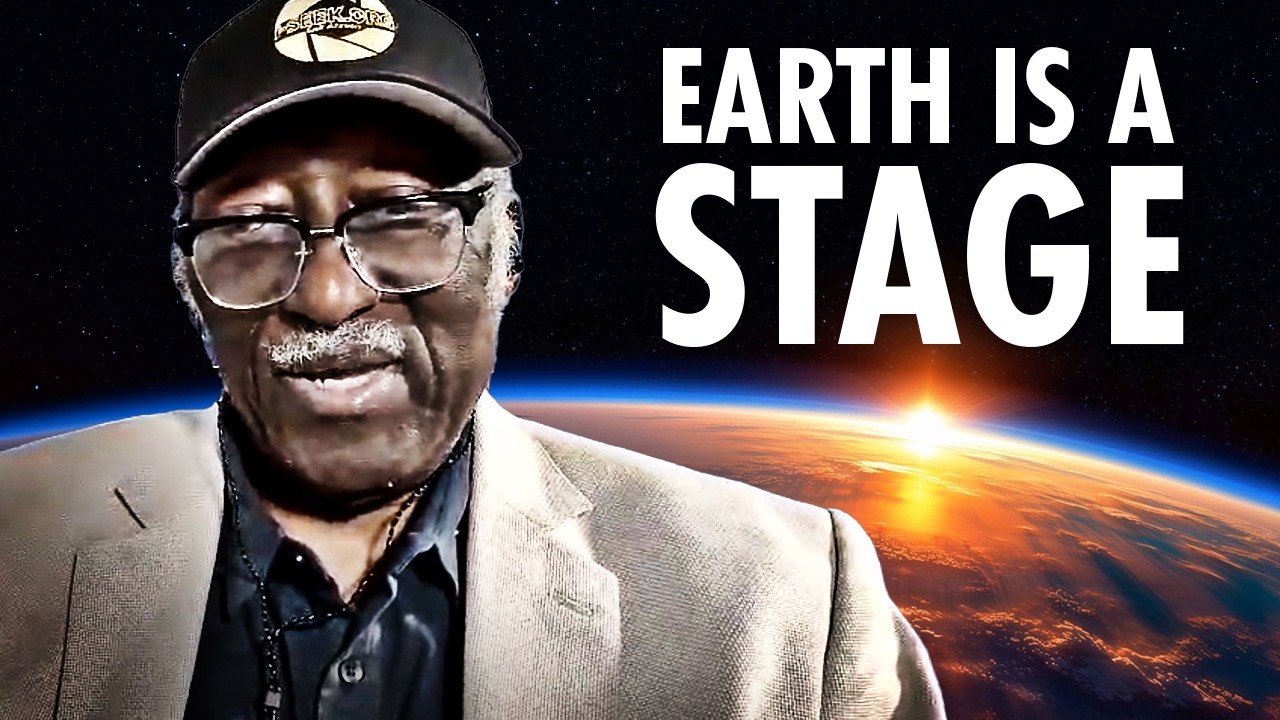
The death itself was unremarkable. No dramatic collapse, no gasping for air. Brinson describes it as happening "noiselessly and painlessly" while he sat in the wheelchair. One moment he was arguing with his wife about whether they needed to go to the bank. The next moment, he simply wasn't there anymore.
The Teacher Who Promised to Meet Him
Professor Dean Brinson had been preparing for this moment since the 1970s, though not in any morbid sense. Back then, he'd met a man named Ishwar Puri in India, the Chief Secretary of Punjab state, responsible for a population roughly the size of the entire United States. Through what Brinson calls a coincidence, this highly intelligent administrator befriended the younger American and became his spiritual teacher.
Before Brinson left India, Puri sat him down on a park bench and raised his voice, wanting him to remember what he was about to say. The message was pointed: "You people in the western part of the world, especially America, including in Europe, you think you know more than what we know. Did you know that all of the world major religion came from the east or the Middle East or the Far East? We imported them, you imported them over there, and you got arrogance."
What Puri taught Brinson was that every human being has the capacity to get out of the physical body, to vacate it and travel into higher worlds, to see the Creator, and then come back and go to work the next day. "I almost fell off the bench," Brinson recalls. "I said wow, I can't think of anything better. He said nor could I, no human being can think of anything better."
The promise Puri made was specific: when Brinson died, his teacher would be there to meet him and escort him. This wasn't metaphorical. Puri told him directly, "I'm going to meet you, why are you afraid? Didn't I tell you I will see you and escort you?"
The Argument That Ended in Death
Spring 2019. Brinson needed hip surgery but had been putting it off out of stubbornness. His wife insisted he at least get a colonoscopy. "What does a colonoscopy have to do with hip surgery?" he protested. She said it would clean out his system. He pointed out he'd been a vegetarian eating plant-based food for nearly 50 years. His organs weren't clogged with cholesterol.
"You know how wives can be if you've been with them for a long time," Brinson says with obvious affection. She won the argument, or seemed to. She put him in a wheelchair and took him to the fourth floor of the hospital to meet the colonoscopist.
Then they started arguing about money. Brinson said he needed to go to the bank. His wife told him to shut up, they weren't going to the bank until next week. He felt the stress building and went quiet. She kept talking as she wheeled him through the door.
He died right there, sitting in the wheelchair.
Watching His Own Rescue
Brinson found himself outside his body, watching his wife notice he'd stopped breathing. She panicked, screaming for nurses and doctors. They rushed over. "My husband is not breathing, what's wrong with him?" She was frantic.
Brinson watched the whole scene unfold, comparing it to Patrick Swayze's character in the movie Ghost. His teacher appeared beside him, exactly as promised. They were both laughing. The medical staff was cutting off Brinson's expensive jacket to get to his chest. He tried to grab their hands to stop them.
"They can't see you," his teacher said. "Your hand will go through the body."
Then his teacher pointed out something remarkable: "You can read their minds." And Brinson could. The senses that all human beings have, he explains, get restricted by the grossness of the physical body. But in that state, he could actually hear what people were thinking. Not just hear, he could see their thoughts forming in their minds before they spoke. Communication happened through telepathy, though you could use words if you wanted to add beauty to the conversation.
"That world is one of truthfulness," Brinson says. In the physical world, people can deceive each other, play games. Unless you have great intuition, you can't tell. But there, deception was impossible.
Through the Roof and Past the Sun
His teacher said, "Let's get out of this place, let's go."
Since there was no gravity, they simply went through the roof of the hospital. They flew extremely fast. Brinson said he wanted to see the sun. His teacher seemed amused: "What's wrong with you? You see the sun every day, it's a boring experience."
They stopped there briefly. Brinson saw it as a huge, gigantic explosion of nuclear energy, nothing but fireballs. He didn't feel any heat but could hear the explosions. His teacher repeated: "What's wrong? You see this every day. Let's leave this boring experience."
Then they traveled at speeds faster than light itself. They crossed the entire galaxy in less than a fraction of a second, passing trillions of stars, suns, moons, planets, asteroids, all kinds of cosmic debris.
The Tunnel and the People Who Remembered
They entered a tunnel. As they moved through it, Brinson started seeing people coming out of the tunnel. Some of them he recognized from earlier lives, from the 1700s, the 1600s, even earlier. His memory was returning.
"The only thing that makes you know that you are at a higher level of consciousness is your memory comes back," he explains. It's like waking from a dream. You don't have to pinch yourself or open your eyes. Your memory just floods back, and you suddenly remember being 16 or 20 or 30 or however old you are in waking life. The same thing happens in the astral world, except the memory that returns spans thousands of years.
When Brinson arrived there, he suddenly woke up and was 3,000 years of age. Some of the people in the tunnel called him by a strange name that he recognized at that moment because his memory was improving. He responded to the name. They asked where he was from. Chicago, he said. They were heading to California and wanted his phone number and address so they could get in touch when they came back.
Brinson gave them his information, knowing they would forget it. Everyone who takes birth in the physical world goes through what he calls "spiritual Alzheimer", a river of forgetfulness. They can't recall where they came from. Sometimes people get flashes, what we call déjà vu, a vague sense of having done something before or met someone before. But you can't put your finger on it because of the Alzheimer.
The World Where Everything Sings
After leaving the tunnel, they entered the lower part of the astral plane, then moved to the middle part where all the heavens and hells exist. "It's a beautiful world," Brinson says. "I don't know how to describe it."
Everything he saw there was seen with senses that had increased in power and awareness. The astral body is made of very refined, subtle matter. You can see in a panoramic 360-degree circle without turning your head. You can see everywhere at once.
Everyone there was extremely beautiful and gorgeous. There were no ugly people. You could create your own body and form it through thought alone. Brinson compares it to how people in the physical world try to stay young with Botox or plastic surgery. "We all want to look young and beautiful," he says. In that world, you just think it and it happens. The average person there looked like they were in their thirties.
There was no pain. Everyone was nonviolent, full of love. You didn't want to leave. The knowledge there came by infusion. You didn't have to read books or spend all night trying to understand Einstein's theory. You just looked at something and the knowledge embedded within it flooded into you, depending on how much concentration you'd developed in the physical world.
That's how this world evolves, Brinson explains. In the 1700s, there were no airplanes, no rockets, no telephones, no computers, no radios, no TVs. But individuals who had studied these activities in the astral world took birth here. With their ability to concentrate, a door hidden behind their eyes cracked open, and knowledge flooded them. They thought it was coming from outside. That's how they made their discoveries. All the knowledge in this world comes from another dimension, through the door of human beings cracking open.
There are people in the astral world with jobs. Some are scientists working on medical projects. Some are athletes perfecting their skills. When they take birth here, they become rare athletes making millions of dollars in different sports. They just have that ability because they practiced there.
"Everybody in that world will experience music," Brinson says. "Everything is full of music." He references the movie The Sound of Music with Julie Andrews, when she sang that the hills are full of music. "Everything is full of music, the mountains, the water. The water has a strange type of intelligence, a life of their own, and everything is following the will of Lord."
That world is a huge world of light. Everything is lit up, including your body. You don't need artificial light from electricity or the sun. Everything has its own light and its own intelligence. Even matter in the physical world has intelligence, though it appears not to. You can take ordinary dirt and turn it into gold if you know how. You can turn it into silver, into houses. Trees give us fuel, cotton for clothing, medicine. "They are givers," Brinson says. "They are humble. They have a life too."
There are administrators in the astral world, beings we call angels or supervisors. The Greeks called them gods. There are many of them, controlling destiny. Then there's a super administrator, like a president, who controls that realm. That president has different departments, just like the Department of Justice in America.
Justice operates differently there. In the physical world, people can't see that justice is real, but Brinson says it's as real as gravity, or more real. "You reap what you sow." Every human being is born with good and bad karma, pulled from the partial akashic records in the astral world. Your job is to seek the Creator.
Brinson wanted to meet the president of that world, one of the big gods who controls destiny and karma. His teacher said no. "If we meet him, he'll want to ask me how he can go further up, and he cannot go further up," the teacher explained. "I would have to tell him he has to come back to Earth, and he doesn't want to come back to Earth, even though he's going to come back."
It's like being born with great wealth in Hollywood, living in a mansion, and being told that to go back to God you have to become poor and homeless. You'd say no, there must be another way. But when you're in heaven, they bribe you. They tell you that when you go to Earth, you're only going to be dreaming, and a dream only lasts a little time because time is different.
Brinson's teacher gave him an example. What if someone came to you with a suitcase containing $5 million, but you had to take a red pill that would give you the most horrible, miserable, horrific, painful dream experience? Then you'd wake up and the money would be yours. Or you could take a blue pill and have a wonderful experience with no money. Most people, if they knew they were going to wake up, would say give me the red pill, because money gives them the ability to travel, become rich, eliminate problems.
That's how they bribe you in the astral plane. They say you're only going to be on Earth for a little while. Take birth, become a Stevie Wonder and be blind. Or be paraplegic. Or get hit by a drive-by bullet at age 12 or 16. You're only going to be there for a little while, and then you can go higher up. So they bribe you to come here to pay off your karma. Karma can be paid off in this world. Animals don't have to pay off karma because they don't exercise free will. Whenever you make a decision, you're exercising the illusion of free will, and that's the only way you create karma.
Beyond the Astral: The Causal Plane
Brinson's teacher took him even higher, beyond the astral world into the causal plane. To give a sense of scale: if you compared the physical universe with its trillions of stars, asteroids, and planets to the astral world, the physical universe would be the size of a quarter and the astral world would be the size of the Pacific Ocean. That's how vast the astral plane is compared to everything we can see with telescopes.
The causal plane is even larger. The astral plane would be like a silver dollar, and the causal world would be like the Pacific and Atlantic Oceans combined.
Once you reach at least the middle part of the causal plane, you start feeling one with everything. "When I say feel, you actually can become one with everything," Brinson clarifies. People become one with things in the physical world, like when your volleyball team wins the championship and you give everyone high fives. You feel one with your teammates but not with the opposition. In that world, you feel one with everything.
We move around in a vicious cycle of birth and death. The only way to cross the causal world, where all the karma and akashic records exist, is to meet a perfect living master. That perfect living master is a rare being. This world always has a perfect living master, but there may only be two, three, four, or five, because the seekers are very few. Most people aren't seeking. They want a house, money, children. They have all kinds of desires. They don't know what the real purpose is. They have many purposes, but these other purposes confuse them and scatter their attention.
The Place Where Words End
As they crossed that world and entered what Brinson calls the world of salvation, he finally got to know who he really was. This is the place Socrates spoke of when he said, "Know thyself." That's where you finally realize that you are a soul made of the same stuff that the Creator's made of, though you still have two more spiritual levels to go.
Your soul is trapped in three bodies: the physical body, the astral body, and the causal body. These are the three bodies which keep the soul revolving in this vicious cycle of birth and death.
When they reached the salvation area, where the soul exists and you don't have to reincarnate anymore, Brinson noticed something profound. Words ceased to exist after leaving the causal plane because the causal plane is a mental world, a mind world. Beyond that, there's no mind, only pure soul.
Brinson asked his teacher if they could go all the way back to the ultimate source. His teacher said no. "You don't want to leave this region," he explained. "This region is gorgeous. You can't come back. You're not going to have it that easy." He told Brinson he would go all the way back when he finally died biologically. "I myself will take you back, because I have to wrap you like a baby in my soul and fly through that world and take you back to your original home."
The Return
Brinson came back. He attributes it partly to the interviewer and other people who pulled him back. "I don't know whether to thank you or get mad at you," he says with a laugh.
He found himself back in the hospital setting. The doctors had worked on him with their tools and instruments. They thought they'd brought him back. Brinson doesn't correct them because that's how this world works.
But he knows what really happened. Everybody who dies will hear a sound. "There's a beautiful sound of a bell, of a higher thing which can take them to the heavens." That sound is what took him out of the body and brought him back.
He references Dr. Raymond Moody's book Life After Life, which documents thousands of near-death experiences. If you read it, you'll learn about the sound these people heard, though they don't always know what it is.
Very few people have had experiences as high as Brinson's. The world is made like this because there are very few seekers, he says. It won't always be like this, but at this time, it is.
What This Experience Reveals
Professor Brinson's account stands out for its unusual combination of specificity and scope. He doesn't just describe the initial separation from the body or a tunnel of light. He maps an entire cosmology, complete with measurements and mechanisms, that he claims to have experienced directly.
The detail about meeting people from past lives in the tunnel who called him by a name he recognized is one of the more intriguing elements. Memory returning in stages as consciousness expands is reported across many NDE accounts, but Brinson describes it as a precise, measurable phenomenon: 3,000 years of memory in the astral plane, millions in the causal plane, and beyond that, something that transcends memory altogether.
What's particularly striking is his matter-of-fact tone about the scale of these realms. The physical universe as a quarter in the Pacific Ocean. The astral plane as a silver dollar in two oceans combined. These aren't poetic metaphors for him. They're measurements he's reporting, like an explorer drawing a map.
The music he describes pervading everything, the water having its own intelligence, the light emanating from all matter, these details appear consistently in NDE literature, but Brinson integrates them into a larger framework. He's not just reporting isolated phenomena. He's describing what he sees as the actual structure of consciousness itself, layered and vast, with the physical world as the smallest, densest expression of something incomprehensibly larger.
His teacher's promise to meet him at death, made decades earlier, and the fulfillment of that promise during the NDE, points to something that challenges our assumptions about time and intention. If consciousness survives death, and if relationships forged in this life persist beyond it, then the boundary between this world and whatever comes next becomes far more permeable than we typically imagine.
Brinson returned with a mission: to share what he learned. Not as dogma, but as a map for anyone willing to look. His teacher told him in the 1970s that every human being has the capacity to do what he did, to leave the body consciously, explore these realms, and return. The fact that so few do isn't a limitation of human nature. It's a matter of attention, of knowing it's possible, of having a guide who's already made the journey.
What awaits us, according to Brinson's experience, isn't judgment or eternal stasis. It's an education that continues across multiple dimensions, with this physical life as the classroom where karma gets resolved and the soul learns through the friction of limitation. The astral world is the university. The causal world is the graduate program. And beyond that, something his teacher says is too beautiful to leave once you arrive.
The most hopeful implication of Brinson's account is that we're not alone in this process. Teachers exist who have mapped these territories and who return, in body or beyond it, to guide others home. The promise his teacher made, to meet him at death and escort him, wasn't metaphorical. It was kept. And if it was kept for Brinson, the logic suggests it's being kept for others, whether they know it yet or not.
For more of Professor Brinson's insights into the nature of consciousness and the afterlife, see his related interview about why we come to Earth and what we're meant to learn here.
Was this article helpful?