Lucas Olles's Near-Death Experience: 'Here Is Where We Live'
A 19-year-old's cardiac arrest revealed a dimension of collective consciousness, reunion with his grandmother, and a message he was told to share
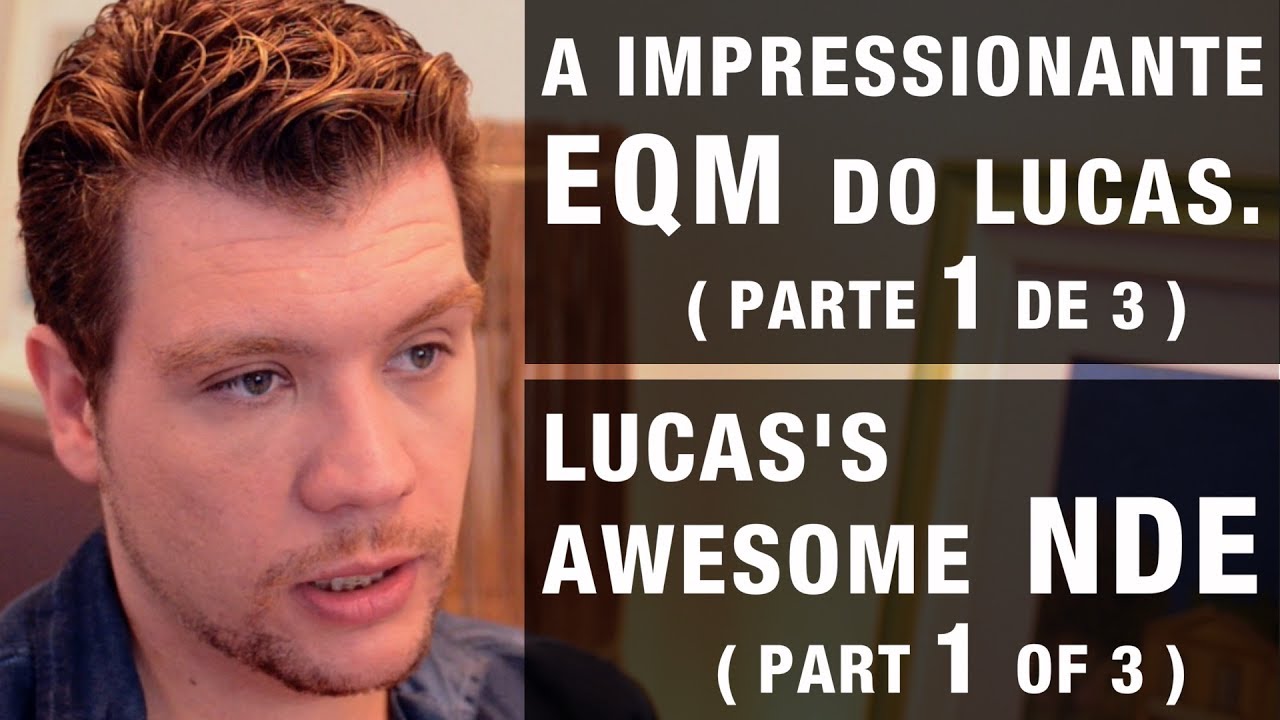
Lucas Olles was 19 years old, working an ordinary job, when he felt a sharp pain in the right side of his neck. Within minutes, the right side of his body went numb. He couldn't speak. His mouth felt as if it were under dentist's anesthesia. He lost consciousness at work and woke up hours later in an ICU corner, watching doctors perform chest compressions on his own body. He thought, clearly and calmly, 'I died.' What followed was not darkness or void, but a journey to a place his grandmother called 'the natural place for us to be,' a dimension where consciousness is collective, communication is telepathic, and love flows between beings like warmth from an invisible sun.
The Stroke That Changed Everything
Lucas Olles worked in culture and entertainment, creating theatrical productions. On September 27th, 2005, he went to work feeling happy and joyful. His job was a little stressful, but nothing out of the ordinary. Around 6 PM, everything changed. He felt a very strong pain in the right side of his neck. The pain was sudden and overwhelming. Within moments, the right side of his body began deadening, pulling, his leg and arm contracting. He couldn't control his limbs. He tried to speak but couldn't form words.
Lucas thought it was just a headache, a common malaise. He kept working. But the situation deteriorated rapidly. He lost consciousness at work. Friends carried him to the lobby where his mother was already waiting. He was taken to the hospital unconscious. CT scans and electroencephalograms revealed an ischemic stroke in a deep, internal area of the left side of his brain. He was admitted to the ICU.
Eight hours after admission, his mother had just entered the ICU when Lucas had a violent convulsion. The seizure was followed by a cardio-respiratory arrest. That's when he had a second stroke. That's when he died.
Waking Up in the Corner
Lucas doesn't remember the time between losing consciousness at work and the moment of cardiac arrest. It was like a dreamless sleep, a blank space in memory. But from the moment his heart stopped, everything became vivid.
He woke up outside his body. He was in a corner of the ICU, looking at his body. He watched the entire scene unfold: the medical staff reacting, nurses and doctors rushing in, his mother being escorted from the ICU, a nurse climbing onto the bed to perform chest compressions. He saw all the procedures that are normal in this type of emergency. He realized and said to himself, 'I died'. He remembers that thought perfectly. 'I died.'
The realization didn't frighten him. He had no negative feelings, no impression like 'oh my God, what now?'. Instead, he was struck by an unexpected thought. Looking at his body, he thought, 'wow, how ugly our body is'. It was a moment of detachment, of seeing the physical form as something separate, something less than what he now was.
Then came the feeling. He was overwhelmed by a feeling of peace. It is very difficult to find words to explain what was happening, he says. He was overcome by a feeling of continuity. And not of an end.
The Vortex of Light
While watching his body in the ICU, Lucas felt a flash. He saw a vortex of light, white. He found himself being taken, as if he were in a fall of a roller coaster, the first fall, but going up. Very fast. No sound at all. Only light, only light. Always with this feeling, a positive feeling.
He doesn't remember sleeping during this transit. At some point, he opened his eyes and was in another place. A place very different. It was no longer the ICU, no longer the hospital. He believes it was no longer here.
The White Platform and His Grandmother
Lucas's memories of this place are solid, detailed, vivid. The main difficulty in describing it is time. It's hard to say how long he was there. He can't measure.
He woke up on a white platform, about five centimeters high, white, in a lawn. There was a person by his side. He could not see the face very clearly, but he knew who that person was. This was the first time Lucas experienced what he calls collective consciousness. He couldn't really see the person but he knew who the person was.
It was his maternal grandmother, who died, he thinks, fifteen years before he was born. She spoke to him. 'Calm. Be at peace, everything is okay. I came here to get you. It's all right'.
Lucas got up. He doesn't remember talking with her in the conventional sense, but he remembers many things she told him. 'You're here, you will not stay here. You're here but you will not stay. You will return. You're only going to stay here for a while. While you are here, we'll talk for a bit and I'll show you a little how it is here'.
He wasn't scared. He was not scared or with some kind of negative feeling. Quite the opposite. The expression that came to him after years of reflection is collective consciousness. There is no individual. Everyone is interconnected. As if all were one thing, really.
A Park Beyond the Physical
His grandmother took him, they strolled around a little, somewhere, in this big open space. It looked like a park. There was a large grove on the left side with tall trees, and a lake on the same left side, really big. He could not see the other shore, the end of the lake. The lake was vast, its far edge invisible.
There were people, many people in groups, scattered in this field. Some of them were wearing what seemed to be togas, white. All talking to each other, all with a smile on the face. The groups were dressed similarly, their clothes simple and uniform.
His grandmother told him something profound. She said that what he went through, what he was going through there, it was something that he had to go through, he had chosen to go through. She said that it is common, this sort of thing. Then she said the words Lucas would carry back with him: 'Here is life. Here is the place where people live'.
She said he would return soon, and he had to return and tell. Multiply this experience.
Lucas remembers walking with her, though when he tried to look down, he didn't see his body. They walked by the lake. It was a lake with a very calm water. He tried to look at the sky, to look up, and there was no sky. There was nothing. All white. A white of a very bright light. He thought, 'wow, how beautiful it is here'.
He asked his grandmother a question. Based on her response, he believes he asked if it was just them who were there. She responded, 'No. There are many here'.
The Teacher and the Group
As they walked, they passed alongside another group, a very large group, about thirty people gathered there, sitting on the floor, and one standing, seeming to be teaching, talking there, getting a lot of attention from people. When they passed by this large group, the standing person waved to Lucas. Then all looked at him and smiled.
At this moment Lucas felt much heat, many good things, nourishing, and a very strong heat. It was a transmission of warmth and welcome that went beyond physical sensation.
Lucas remembers flashes of places, all within this open area. He remembers seeing how the connection between those beings who were on that other side works. Then his grandmother took him back. They turned around in a place full of flowers, many flowers, many flowers. She took him back to this platform, this big square of wood, white.
'Now you will return. Everything will be all right. Do not worry, do not be afraid. You will go back and everything will be OK'. Then she said something Lucas would spend years trying to understand. 'But do not forget. It is here that we live. Here is the natural place for us to be. Go back and tell'.
One of the things his grandmother said is, 'All you're learning here, everything that you see, use for good. Report, tell, and use for good. Use for good'. Later, long after the return, Lucas understood what would be this 'good'.
She didn't send any message to anyone. That's when Lucas felt a little fear. He believes he didn't want to return. Maybe it was because of the last picture he'd seen of his body, the ugly, damaged thing on the ICU bed. He didn't want to return to that place where those things were happening. He felt a little fear, he was maybe afraid.
The Fall Back
His grandmother took him to the platform on the ground. He remembers lying on it. Then he had again that feeling of falling, very strong. Very strong. The roller coaster metaphor was perfect. Then he woke up, in a very strong impact.
But he didn't wake up immediately after his cardiac arrest. He woke up a long time after. He woke up at the moment he was being intubated. He looked up and saw a lot of white heads on top of him. 'Lucas, are you okay? Lucas, blink, blink'. Days had passed.
Lucas doesn't think he came back the same.
The Aftermath: A New View of the World
Lucas believes what has changed the least was physically. You come back with a different view of the world, of wider boundaries. You understand that there is something there that not necessarily religion or science explains.
The fear of death? None. Nothing, nothing, nothing, nothing. It is a breath. He believes it is welcome at some moment.
The memory of the experience came back immediately. He woke up with the doctors doing the intubation procedure. A doctor told him, 'Lucas, you had a stroke, serious. I do not know if you are understanding me. If you're aware, blink'. But at that moment, he had the recent memory of having passed through that experience with his grandmother, with those people in that place, and he wanted to talk. He woke up very nervous and wanting to talk, but he couldn't. He was very ill, his mouth was displaced, unable to speak. He went back to talking months later.
The return to the body was painful. The return, this entry in the body hurts the body a bit. It hurts. He was in a place, on a level, where you do not feel pain. Not at all. And suddenly, to enter the body, you enter with pain.
Lucas endured six catheterizations, countless spinal fluid collections, needles, tests. It was very difficult. He was always willing to talk, to report, to tell, 'Hey, I'm...', to scream, 'There is another side, there is another place.' And he could not. His mouth was displaced, he could not speak, he babbled. It took time for his brain to reconnect the person with the name. It took a while for him to know who was who.
During his recovery, Lucas had a strange experience. He remembers hearing everything. All the talk with the doctors. Everything. He screamed inside himself, 'I'm here, I'm here, I'm here'. He remembers everything. He remembers the nurse running a hand on his forehead, his mother. Although he was, in quotes, unconscious, as the doctors say, 'he is unconscious,' he was aware, he was hearing everything. All the talk of the doctors, the noise of the hospital, everything.
He believes it was the second option, that he was actually there, present in the physical body, without sedative, already awake and listening to everything. He remembers returning to the body, having this shock, and waking up inside the body, and the body sleeping, the body turned off. He was fully conscious. His mother said that he was in bed like a vegetable, a person in a coma for a long time, without any reaction, none. But he was totally connected to what was happening in his surroundings. He remembers sleeping inside this state, and waking up inside his body that was turned off. It is very strange trying to explain.
The consciousness he had while out of the body was different from the consciousness inside his body. Consciousness in the body is greatly reduced. Out it is universal. He felt a feeling of oneness with the universe.
The hardest thing for Lucas to explain is the idea of collective, of universal consciousness. He felt part of a whole. He felt a little of what his mother was feeling here, of what his friends were feeling here, of what people who he didn't know were feeling here, and not just here. It's as if he had a connection with each person. Here and there. When people waved to him, smiled to him, he felt their sincerity and their joy at seeing him there. But also, very distantly, he felt the sadness of his mother here, for example.
New Abilities
Lucas believes he developed some features he didn't have before. He experiences it all the time. In some moments of his routine, this routine that we have here, physical, material routine, somewhat futile when compared to the place where he's been, in some moments he has contact with there. With there. He has contact with that place. And with who is there. Not that he goes there. But people from there come here. This didn't happen before. No, no, no.
Lucas Olles is not religious in the conventional sense. He attends a few religions. But if he tells you that he interprets all that he went through and still goes through as something religious, he will be lying. It's not possible for him. Because it is almost part of life, part of the routine. He doesn't need to go to a religious sphere to understand what is happening because for him it is physical, is palpable, that place exists, that's where we all really live, that place is the common, that's where we have to go back, to stay there, because that place is our place. At times, some people from there, some beings from there, for some reason, they come here and get in touch. He does not understand this as something religious. Because he thinks the religion creates a distance.
What Makes This Account Significant
Lucas Olles's experience is one of the most detailed and articulate accounts of what experiencers call the life review's inverse: not a review of one's own life, but an introduction to the life that continues after physical death. His grandmother's statement, 'here is life, here is the place where people live,' inverts our usual understanding. What we call life is the temporary state. What we call death is the return home.
The detail Lucas provides about collective consciousness is consistent with thousands of other NDE accounts. Experiencers across cultures, religions, and centuries describe the same phenomenon: a state of being in which individual boundaries dissolve, in which you know what others know, feel what they feel, and recognize that separation was always an illusion of the physical plane. Lucas's inability to see faces clearly but knowing exactly who people were is a recurring feature. Identity on the other side isn't carried in facial features or names. It's intrinsic, immediate, unmistakable.
The telepathic communication Lucas describes, where no one spoke, where he didn't see mouths move, but where information flowed directly from consciousness to consciousness, appears in the majority of detailed NDE reports. It's not that language doesn't exist there. It's that language is unnecessary. Thought itself is the medium.
Lucas's description of the return is also significant. The pain of re-entering the body, the shock of the impact, the immediate contrast between the peace of that place and the suffering of the physical form, these are common themes. Many experiencers describe the return as traumatic, not because they fear life, but because they've tasted something so much more expansive that the body feels like a cage.
What stands out most in Lucas's account is the message. His grandmother told him to return and tell, to multiply the experience, to use what he learned for good. This is the experiencer's burden and gift. They come back with knowledge that can't be fully translated into language, but they're compelled to try. Lucas Olles has done that. His story, told with precision and humility, adds to the growing body of evidence that consciousness is not produced by the brain, that death is not an ending, and that the universe we inhabit is far more loving, far more interconnected, and far more intentional than our materialist culture allows us to believe.
For those interested in exploring more of Lucas Olles's experience, he shared additional details in subsequent interviews, including descriptions of other forms of life he encountered on the other side. His willingness to speak openly about what he saw and felt is a gift to all of us still navigating the physical realm, wondering what comes next. Lucas knows. He's been there. And he came back to tell us: here is not where we live. There is.
Was this article helpful?