Does my identity dissolve into a cosmic "oneness" where I disappear — or do I stay myself?
The most consistent finding in 50 years of NDE research: you remain distinctly you, even when merged with everything.
You stay yourself. That's the short answer, and it's backed by thousands of accounts. People who've clinically died and returned describe an experience of radical interconnection, yes, but not dissolution. They report feeling more themselves than they ever did in a body. The fear that you'll be absorbed into some impersonal cosmic soup, losing your memories and personality, doesn't match what experiencers actually report. What they describe is closer to this: imagine finally understanding a language you've been hearing your whole life but couldn't translate. The words don't replace you. They just make sense now.
See a short answer and related videos →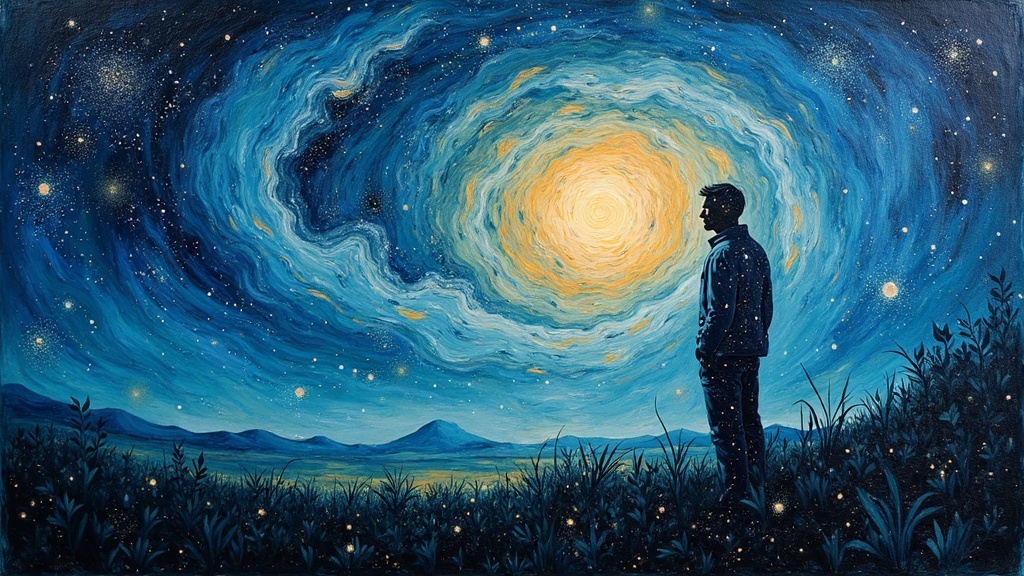
The question sits at the heart of what scares people most about death. Not pain. Not the unknown. The fear that you won't be there to experience whatever comes next. That the "I" reading this sentence will dissolve like sugar in water, leaving only sweetness but no shape. It's a reasonable fear if you assume consciousness is a product of brain activity, because then identity is just a pattern of neurons firing, and when the brain stops, the pattern should collapse. But near-death experiencers don't report collapse. They report the opposite.
The Paradox Nobody Expected
Here's what researchers found when they started systematically collecting accounts in the 1970s: people who've been clinically dead describe feeling simultaneously individual and universal. They're still themselves, with their specific memories, personality quirks, and sense of "me-ness," but they're also aware of being part of something infinitely larger. It's not one or the other. It's both at once.
That paradox shows up again and again. One experiencer on Project Profound put it bluntly: "It was like I was still me, but I wasn't." Another woman, describing her NDE after being struck by lightning, said: "We stay who we are; I did not lose my identity at all; I was still me; I still looked like me and felt like me and thought like me; I was still me." No ambiguity there. She didn't merge into an undifferentiated ocean of light. She remained a distinct point of awareness.
But then there's this account from Ellen Whealton, who described her experience differently: "I was completely emerged. There was no me. There was no personality. I was part of something bigger. I was connected to something greater." So which is it? Do you stay yourself or not?
The answer seems to be: both, and the contradiction isn't a bug. It's the core feature of what happens when individual consciousness encounters its source. You don't lose your identity. You discover it was never as separate as you thought.
What the Research Shows
Raymond Moody's 1975 book Life After Life was the first to systematically document this pattern. He interviewed 150 people who'd been resuscitated after clinical death, and one of the most consistent elements was the preservation of self-awareness. People didn't report becoming someone else or forgetting who they were. They reported being fully conscious, often more conscious than they'd ever felt in their bodies, with all their memories intact.
Pim van Lommel's 2001 Lancet study of cardiac arrest survivors found the same thing. Eighteen percent of patients who were clinically dead during resuscitation reported NDEs, and those who did consistently described maintaining their sense of identity throughout the experience. They recognized themselves. They thought in their own voice. They remembered their lives. What changed wasn't who they were but their understanding of what "who they were" actually meant.
Bruce Greyson, who spent 50 years studying NDEs at the University of Virginia, has emphasized this point repeatedly: the self doesn't dissolve. It expands. People report feeling like they've been living in a cramped room their whole lives and suddenly walked outside. The room was real. It's still there. But now they can see it was never the whole building.
The "Me" That Remains
So what exactly persists? Experiencers describe retaining:
Memory: They remember their name, their family, their life history. Often in vivid, panoramic detail that includes events they'd forgotten.
Personality: Their sense of humor, their emotional tendencies, their way of thinking. One account describes feeling "very much uniquely me, and that my personality and who I was was intact, and that it was just my unique self."
Agency: They make choices. They decide whether to stay or return. They ask questions. They're not passive witnesses to some cosmic slideshow.
Relational identity: They recognize deceased loved ones, who recognize them in return. These aren't generic encounters with "beings of light." They're specific people who remember specific relationships.
What drops away is the feeling of being fundamentally separate from everything else. That boundary dissolves. But the contents of the self, the unique configuration of consciousness that makes you you, remain intact.
Melissa Denyce, describing her pre-birth memory, captured this perfectly: "And I was still me, as I would describe me as an individual consciousness, but I also contained and knew everything else." Not one or the other. Both.
The Oneness That Doesn't Erase
The confusion comes from how we talk about mystical experiences. We use words like "unity" and "oneness" and "merging," and those words carry baggage. They suggest obliteration. A drop returning to the ocean and losing its dropness. But experiencers don't describe it that way. They describe it more like realizing the drop was always made of the same substance as the ocean, and the boundary between them was an illusion of perspective, not a fact of nature.
Think about how you experience your body. Your hand is you. Your foot is you. They're distinct parts with different functions, but they're both you. You don't feel like your hand dissolves into your foot when you recognize they're part of the same organism. They remain differentiated within a unified whole. That seems to be closer to what experiencers describe: consciousness is one substance expressing itself through infinite individual forms, and death reveals the unity without erasing the form.
This isn't just poetic language. It's a consistent phenomenological report. People who've had these experiences don't come back saying, "I lost myself." They come back saying, "I finally found myself, and I was so much more than I thought."
Why the Fear Persists
If the evidence is this consistent, why does the fear of dissolution persist? Partly because we've inherited a conceptual framework that makes individuality and universality seem mutually exclusive. Western philosophy, especially since Descartes, has treated the self as a discrete, bounded thing. Either you're a separate individual or you're not. The idea that you could be both simultaneously doesn't fit the categories.
Eastern philosophy has always been more comfortable with paradox. Buddhism talks about anatman (no-self) but also about rebirth, which requires some continuity of identity across lifetimes. Advaita Vedanta describes the individual self (atman) as identical with the universal self (Brahman) without collapsing the distinction. These traditions have language for what NDErs describe. We don't, really. So we default to the language of loss.
But there's something else going on, I think. The fear of losing yourself is, at bottom, the fear of not mattering. If you dissolve into an impersonal oneness, then your specific life, your struggles, your loves, your particular way of seeing the world, all of it becomes irrelevant. Just a temporary eddy in an infinite stream. And that feels unbearable.
NDE accounts suggest the opposite. Your specific life matters intensely. Every choice, every relationship, every moment of growth or failure is preserved and matters. The life review component of NDEs, which roughly 20-25% of experiencers report, involves experiencing your entire life from every perspective, including the perspectives of people you affected. That's not dissolution. That's radical accountability. You don't get to escape into cosmic anonymity. You have to own every bit of who you were.
What About the Accounts That Sound Like Dissolution?
There are accounts, like Ellen Whealton's, that emphasize merger over individuality. "There was no me. There was no personality." How do we square that with the accounts that emphasize continuity?
One possibility: it's a matter of emphasis and language. Trying to describe an experience that transcends ordinary categories forces you to choose which aspect to highlight. If you emphasize the unity, you say "I dissolved." If you emphasize the continuity, you say "I remained myself." Both might be true simultaneously, and the experiencer is just picking which facet to foreground.
Another possibility: different people have different experiences, or different phases of the same experience. Some NDEs are brief, others extended. Some involve immediate return to the body, others involve what feels like extended time in another realm. It's possible that the sense of individual identity is more prominent in some phases and the sense of unity in others.
But here's what's striking: even the accounts that emphasize dissolution don't describe it as loss. Ellen Whealton didn't say, "I was terrified because I stopped existing." She said she was "part of something bigger," "connected to something greater." The emotional tone is expansion, not annihilation. And when these experiencers return to their bodies, they return with their memories, personalities, and sense of self intact. Whatever dissolution occurred, it was temporary and didn't erase the underlying structure of identity.
The Divided Self Hypothesis
There's an interesting paper by Raymond L. M. Lee while also experiencing unity with everything (transpersonal self). Both are real. Both are you. Ordinary waking consciousness privileges the personal self so completely that the transpersonal self is invisible. Death, or the approach to death, shifts the balance. The transpersonal self comes forward. But the personal self doesn't vanish. It's still there, just no longer the only thing you identify with.
I don't know if that's the right explanation, but it fits the data better than either pure continuity or pure dissolution. It accounts for why experiencers describe both at once without contradiction.
What This Means for You
If you're reading this because you're afraid of losing yourself at death, the evidence suggests you can relax. You won't dissolve. You won't become someone else. You won't forget your life or the people you love. What you'll lose is the illusion that you were ever separate from them in the first place.
That might sound abstract, but experiencers describe it as the most concrete, vivid, real thing they've ever encountered. More real than physical reality. One common phrase: "This life is the dream. That was waking up."
You'll still be you. Just a bigger, clearer, more complete version of you. The version that was always there, underneath the fear and the forgetting and the constant noise of being alive in a body. If someone dies while deeply depressed or afraid, could their mental state pull them into a dark experience? That's a related question worth exploring, because it touches on how your state of consciousness at death might shape the initial experience. But even in difficult NDEs, experiencers report maintaining their sense of self. The content changes. The "I" experiencing it doesn't disappear.
You don't lose your identity at death. You discover it was never as separate as you thought, and the boundary between "you" and "everything else" was an illusion of perspective, not a fact of nature.
The Counterargument: Wishful Thinking and Constructed Narratives
The obvious objection: people want to believe they'll survive death, so they construct narratives that reassure them. The brain, starving for oxygen, generates a comforting hallucination of continuity. Of course experiencers report staying themselves. What else would a dying brain produce?
That's a fair objection, and it's worth taking seriously. If NDEs were just random hallucinations, we'd expect massive variation in what people report. Some would describe becoming someone else. Some would describe total confusion about their identity. Some would report forgetting their lives entirely. But that's not what we see. The consistency across cultures, ages, and circumstances is striking. The preservation of identity is one of the most stable elements.
Moreover, many experiencers report things they couldn't have known through normal means. The veridical NDE cases, where people accurately describe events that occurred while they were clinically dead and their eyes were closed, suggest something more than hallucination. Pam Reynolds, during brain surgery with her eyes taped shut and her brain activity flatlined, accurately described the surgical instruments and conversations in the operating room. She didn't lose her identity during that experience. She was fully herself, watching from outside her body, and she remembered it all when she returned.
The wishful thinking objection also doesn't explain why so many experiencers initially resist the experience or try to return immediately. If the brain were just generating comforting fantasies, you'd expect pure bliss and no conflict. But many accounts include struggle, difficult realizations, and the experiencer arguing with deceased relatives or beings of light about whether to stay or return. That's not the pattern you'd expect from a hallucination designed to comfort.
Still, I'll admit: I can't prove the experiencers are right. I can only point to the consistency of their reports and the fact that many of them include verifiable details that shouldn't be accessible to someone whose brain isn't functioning. That's not nothing, but it's not proof. If you're committed to the idea that consciousness is produced by the brain and can't exist without it, no amount of anecdotal evidence will convince you. You'll find a way to explain it away.
What I can say is this: the evidence we have suggests you don't lose yourself. And if you're going to bet on what happens after death, betting on the consistent reports of thousands of people who've been there seems more reasonable than betting on a materialist framework that can't explain consciousness in the first place.
Why Individual Consciousness Might Be Fundamental
There's a broader question here about the nature of consciousness itself. If consciousness is fundamental, not produced by the brain but filtered or localized through it, then individual identity might be a permanent feature of reality, not a temporary accident of biology. You'd be a distinct point of awareness within an infinite field of consciousness, and death would just be the removal of the filter, not the end of the point.
That's the view suggested by NDEs. It's also the view suggested by other lines of evidence: children's verified past-life memories (Ian Stevenson, Jim Tucker), shared death experiences where multiple people witness the same event, deathbed visions that include accurate information the dying person couldn't have known. All of it points toward consciousness as primary and individual identity as a stable structure within it.
If that's true, then the fear of dissolution is misplaced. You're not a wave that will collapse back into the ocean. You're a note in an infinite symphony. The symphony is made of the same substance you are, and you're inseparable from it, but you don't stop being your specific note. You just hear the whole song.
That's the picture that emerges from the data. It's not proof. It's a pattern. But it's a consistent pattern, reported by people from every culture and background, and it's been stable for as long as we've been collecting accounts. You stay yourself. You just discover you were never as small or as separate as you thought.
References
- 1.[Book]Moody, R. (1975). Life After Life. Mockingbird Books.
- 2.
- 3.
Was this article helpful?