Anita Moorjani: Dying of Cancer Showed Her We're Already Whole
A woman at the edge of death discovered that fear, not disease, was the real enemy
Anita Moorjani's body was shutting down. Her organs were failing. Tumors the size of lemons riddled her lymphatic system. After four years of fighting lymphoma, her doctors told her family there was nothing left to do. But in that moment, as her physical form collapsed, Anita discovered something that would change everything she thought she knew about illness, healing, and what it means to be human. She found herself in a state of such profound clarity and peace that returning to her dying body felt like stepping back into a prison. What she brought back with her wasn't just her life. It was a message about the nature of reality itself.

The Woman Who Stopped Fighting
Before February 2, 2006, Anita Moorjani was a woman at war with herself. Born in Singapore to Indian parents and raised in Hong Kong, she'd spent most of her life trying to fit into cultures that never quite felt like home. She worked in corporate life, always aware of being different, always trying to be smaller, quieter, more acceptable. When her best friend died of cancer, that fear found a new target. Anita became obsessed with preventing the disease, reading everything she could find about carcinogens, changing her diet, avoiding chemicals. The irony wouldn't be lost on her later: despite all her vigilance, or perhaps because of it, she was diagnosed with Hodgkin's lymphoma in April 2002.
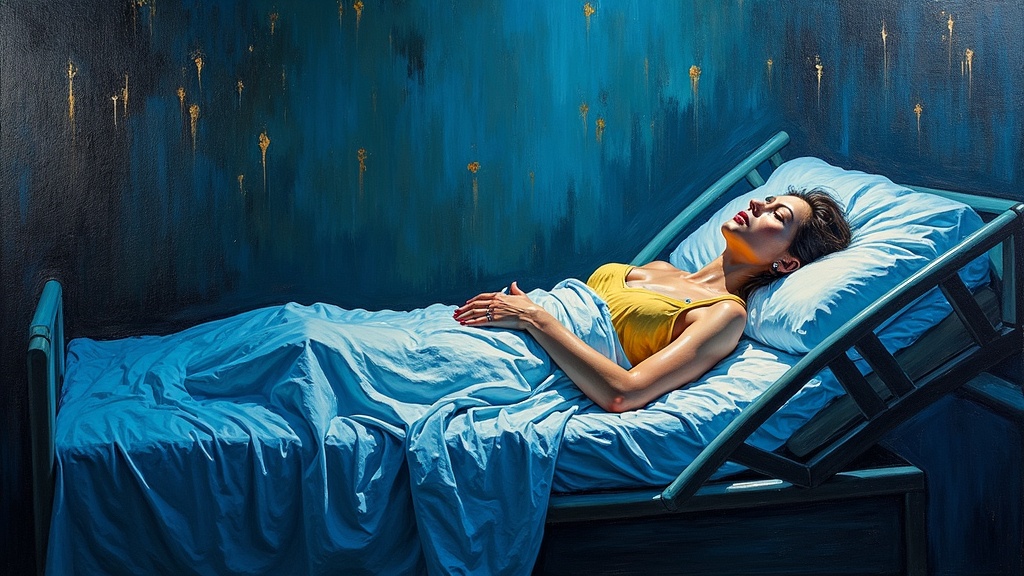
For four years, she tried everything. Conventional treatment, alternative therapies, dietary protocols, spiritual practices. Nothing worked. The cancer spread. By early 2006, her body was failing in every measurable way. Her organs were shutting down. Tumors had grown so large they were visible beneath her skin. She couldn't walk without assistance. She couldn't eat. On the morning of February 2nd, her husband Danny rushed her to the hospital in Hong Kong. She slipped into a coma. The doctors told her family to say their goodbyes.
What happened next defied every assumption Anita had built her life around.
Beyond the Body
Anita didn't experience her death as an ending. She experienced it as an expansion. One moment she was in her failing body, the next she was everywhere and nowhere, aware of everything happening around her physical form but no longer confined to it. She could perceive her husband standing outside the hospital room. She knew her brother was on a plane from India, knew the conversation he'd had with his wife before boarding. She was aware of the doctors working on her body, aware of her mother's grief, aware of details she couldn't possibly have known from a hospital bed.
But the awareness of earthly events was the least significant part of what she experienced. What struck her most profoundly was the feeling. "I felt incredible. I felt free," she would later say. Free from the pain that had consumed her for years. Free from the fear that had shaped her entire life. Free from the constant sense that she wasn't enough, wasn't doing enough, wasn't being enough.
In this expanded state, Anita encountered what she describes as pure, unconditional love. Not the conditional love she'd known on earth, not the love that required her to be a certain way or do certain things. This was love without boundaries, without judgment, without the possibility of failure. She felt completely accepted, completely known, completely whole. Every choice she'd ever made, every mistake, every moment of fear or shame, all of it was held in this vast, compassionate awareness that saw only her essence, her inherent worth.
She wasn't alone in this space. She sensed the presence of her father, who had died ten years earlier. She felt her best friend Soni, the one who'd died of cancer, the death that had triggered Anita's own spiral of fear. These weren't visions or hallucinations. In her experience, these presences were more real than anything she'd encountered in physical life. They communicated without words, a direct transmission of meaning and emotion that made language seem clumsy and inadequate.
The Understanding That Changed Everything
What Anita received in this state went beyond comfort or reassurance. She describes it as a download of understanding, a sudden, complete knowing about the nature of reality and her place in it. She understood that she'd never been broken, never needed fixing. The cancer hadn't been a punishment or a failure. It had been her body's response to years of fear, years of believing she wasn't good enough, years of betraying her authentic self to meet others' expectations.
She saw her entire life from this expanded perspective. Every moment of self-judgment, every time she'd made herself smaller, every choice driven by fear rather than love. And she understood, with absolute clarity, that none of it had diminished her true nature. She was, and had always been, an expression of the infinite. The illness had been a physical manifestation of spiritual self-betrayal, her body's way of screaming what her heart had been whispering: this isn't who you are.
In this state, Anita had access to what felt like universal knowledge. She understood that time wasn't linear, that all moments existed simultaneously. She grasped the interconnectedness of all life, how every action ripples through the fabric of reality. She saw that what we call death is simply a transition, a return to our natural state of expanded awareness. Physical life, she understood, was the limited state, not the other way around.
And she was given a choice.
The Decision to Return
Anita could stay in this state of bliss and freedom, or she could return to her dying body. There was no pressure, no judgment about which path she chose. But she was shown that if she returned, her body would heal. Not gradually, not partially. Completely. The cancer that had ravaged her for four years would disappear. She would recover in a way that defied medical explanation, and her healing would serve a purpose: to share what she'd learned, to help others understand that they too were whole, that fear and self-judgment were the real diseases.
The choice wasn't easy. Returning meant stepping back into pain, back into limitation, back into a world that often felt hostile and overwhelming. But Anita also understood that she wouldn't be returning as the same person. She would come back with the knowledge of who she really was, with the felt experience of unconditional love, with the understanding that nothing, not even death, could diminish her essence. Armed with that knowing, she could live differently. She could be herself without apology, without fear, without the constant need for external validation.
She chose to return. For her husband. For her family. For the message she now carried.

The Healing That Shouldn't Have Been Possible
When Anita regained consciousness, she tried to tell the doctors what had happened. They weren't interested in her experience. They were interested in the fact that she was still alive, which they hadn't expected, and that her organs were beginning to function again, which they couldn't explain. Within days, the tumors began shrinking. Within weeks, they were gone. Her doctors ran test after test, looking for any trace of the cancer that had been killing her. They found nothing.
Five weeks after arriving at the hospital in a coma with hours to live, Anita walked out cancer-free. Her medical records documented the transformation but offered no explanation for it. Her oncologist called it a spontaneous remission, one of the most dramatic he'd ever seen. Anita knew it was something else. It was the physical manifestation of an internal shift, her body responding to the change in her consciousness, to the release of the fear and self-judgment that had been poisoning her for years.
The healing wasn't just physical. Anita found herself fundamentally changed by what she'd experienced. The fear that had dominated her life was gone. Not suppressed or managed, but actually absent. She no longer worried about what others thought of her. She no longer tried to make herself acceptable to cultures or communities that demanded she be someone other than who she was. She spoke her truth, lived her truth, trusted her inner knowing in a way that would have been impossible before.
Her relationships transformed. Her marriage deepened. Her connection to her family became more authentic. She found herself drawn to share her experience, first with small groups, then with larger audiences. She wrote a book, Dying to Be Me, that became an international bestseller. She began speaking around the world, helping others understand that they didn't need to nearly die to access the truth she'd discovered: that we are already whole, already loved, already enough.
Living From the Other Side
More than fifteen years after her NDE, Anita continues to share what she learned in those hours beyond her body. She speaks at conferences, appears in documentaries about near-death experiences, and works with people who are facing their own health crises or spiritual awakenings. Her message has remained remarkably consistent: fear is the real disease, and love, unconditional self-love, is the cure.
She's learned to navigate the skepticism that often greets accounts like hers. In conversations about integrating her NDE, she acknowledges that not everyone is ready to hear what she has to say, and that's okay. She's not trying to convince anyone. She's simply offering what she knows to be true from her own experience. For those who resonate with her message, it can be life-changing. For others, it might plant a seed that grows later.
What strikes people who meet Anita now is her groundedness. Despite having experienced something so extraordinary, she doesn't position herself as a guru or spiritual authority. She's simply someone who died, learned something profound, and came back to share it. She still deals with everyday challenges. She still navigates a world that often operates from fear rather than love. But she does so with an unshakeable knowing that this physical reality isn't all there is, that death isn't an ending, and that the love she experienced on the other side is always available, always present, if we can quiet the fear long enough to feel it.
Her story continues to reach new audiences through various platforms and interviews, each retelling offering slightly different details or emphases depending on what the audience needs to hear. But the core remains the same: she was dying, she crossed over, she discovered she was already whole, and she came back to tell us that we are too.
What Anita's Experience Reveals
Anita Moorjani's account sits among thousands of documented near-death experiences, but certain elements make it particularly significant for understanding the nature of consciousness and healing. The dramatic physical recovery, documented in medical records, challenges the assumption that consciousness is merely a product of brain chemistry. If her healing was triggered by a shift in awareness that occurred while her brain was compromised, it suggests that consciousness operates through the body rather than being produced by it.
The verified perceptions she reported, details about her brother's flight and conversations happening outside her room, align with a well-documented feature of NDEs: the acquisition of information that shouldn't be accessible to an unconscious person. These veridical perceptions have been studied extensively by researchers like Pim van Lommel and Sam Parnia, and they consistently point toward consciousness existing independent of physical brain function.
But perhaps the most profound aspect of Anita's experience is what it reveals about the relationship between consciousness, belief, and physical health. Her understanding that the cancer was a manifestation of years of self-judgment and fear suggests that our thoughts and emotions have a more direct impact on our physical bodies than conventional medicine typically acknowledges. This isn't about blaming people for their illnesses. It's about recognizing that we are integrated beings, that the separation between mind and body is an artificial construct, and that healing often requires addressing the consciousness that animates the body, not just the body itself.
The unconditional love Anita describes encountering is one of the most consistent elements across thousands of NDE accounts. Experiencers use different language to describe it, some calling it God, others calling it Source or the Universe or simply Love. But the feeling is remarkably similar: a love so complete, so accepting, so vast that it dissolves every fear, every judgment, every sense of unworthiness. This isn't a religious concept imposed on the experience. It's the direct perception of what consciousness feels like when it's not filtered through the limiting beliefs and fears we accumulate in physical life.
What makes Anita's story particularly valuable is how she's translated that experience into practical wisdom for living. She isn't telling people to abandon medical treatment or ignore physical symptoms. She's inviting them to examine the fears and beliefs that might be contributing to their suffering, to question the self-judgments that diminish their sense of worth, to consider that healing might require becoming more fully themselves rather than trying to fix what's broken. In a culture that often treats the body as a machine to be repaired and the self as a project to be improved, her message is radical: you're already whole, you've always been whole, and remembering that truth might be the most powerful medicine available.
For those of us who study these experiences, Anita's account offers a glimpse of what awaits all of us when we eventually make that transition. Death isn't an ending but an expansion, a return to a state of clarity and love that's our natural condition. Physical life, with all its pain and limitation and fear, is temporary. What's eternal is the consciousness that animates these bodies, the awareness that continues beyond physical death, the love that holds all of existence. Anita died to remember that truth. The rest of us get to learn it without having to go to the edge first. That's the gift she's offering, and it's one worth receiving.
Was this article helpful?